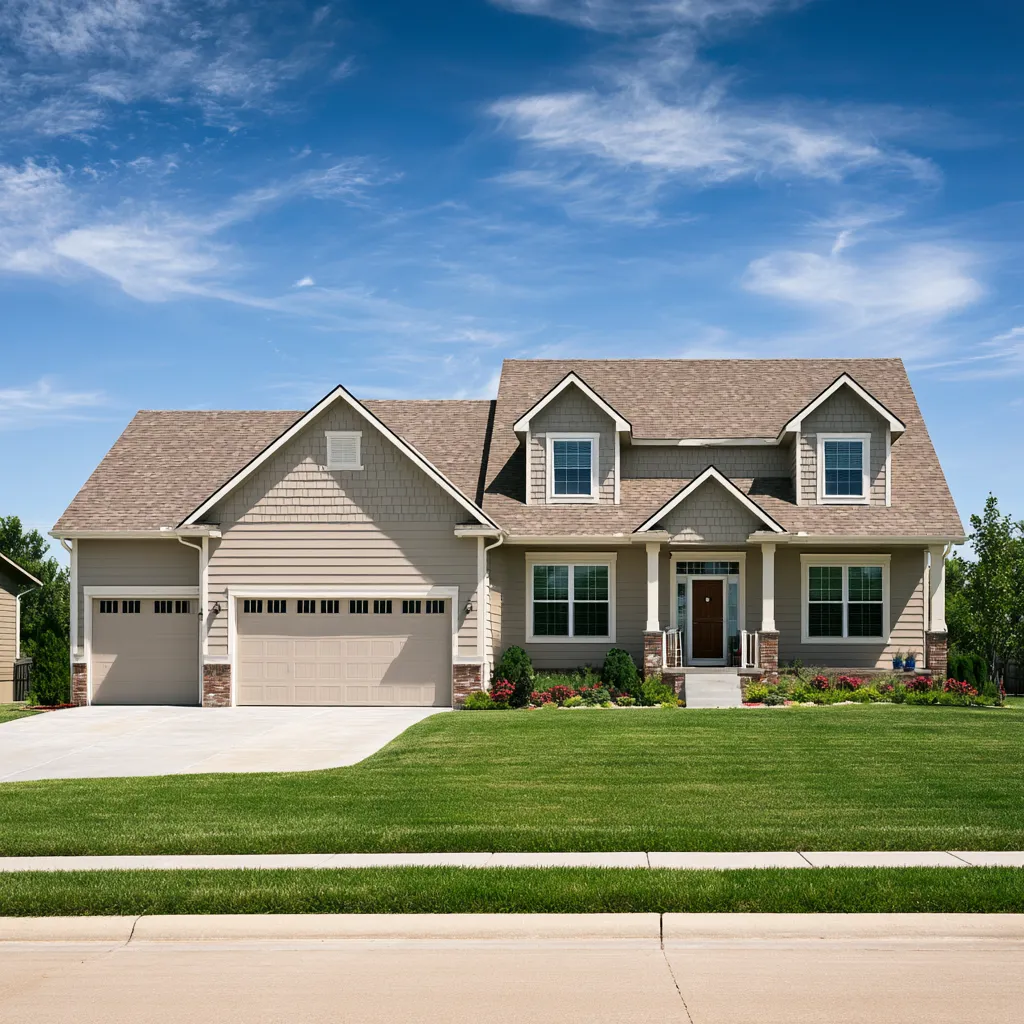
Wind is the storm damage nobody around here goes looking for. After hail, half the street is out in the yard squinting up at the shingles. Wind leaves less to squint at, and on the lakefront side of Rowlett it does more work than most owners expect. If your house sits where Lake Ray Hubbard opens up in front of it, your roof is not taking the same weather as a house a couple of miles inland, and after a hard night that difference is worth ten minutes of your morning. Here is what the open water changes, what you can see for yourself from the ground, and when it is worth having somebody up there.
Open water gives wind nothing to slow it down
Wind loses most of its punch to whatever it has to climb over. Inland, a gust crossing Rowlett works its way over fence lines, garages, grown trees and one roofline after another. Every one of those takes a little out of it and breaks the rest into eddies that hit at odd angles and die out fast. By the time that wind reaches a house sitting in the middle of a subdivision, it's already spent itself on a couple of blocks of obstacles.
There's none of that over Lake Ray Hubbard. Water's smooth, and wind crossing a wide stretch of it keeps what it started with. The first thing standing in its way is the shoreline, and right behind the shoreline are the houses on it. Bayside and Sapphire Bay sit on the peninsula south of Interstate 30, so what lies in front of those houses is open lake for a long way, and the lake face of a house there meets weather that streets further in never see in the same form.
None of that makes a lakefront roof a bad roof. It makes the wind load on one part of town genuinely different from the wind load two miles west, and our roofers walk a house on the water with that in mind.
Wind peels a roof from its edges inward
Wind doesn't punch holes in a roof. It peels. Every asphalt shingle carries a strip of adhesive bonding it down to the course below, and that bond's the only thing holding the bottom edge of the tab flat against the roof. Wind gets a fingernail under an edge, breaks the bond, and folds the tab back on itself. When it drops again it holds a crease across its width.
The crease is the part worth knowing about, because it outlives the storm. A creased shingle lies back down and looks close to normal from the driveway, and it won't re-seal. The bond's gone, so the next gust gets under it easier than the last one did, and rain driven sideways has a way in that it didn't have a week ago. That's how one windy night turns into a ceiling stain in the spring.
Where it starts is the perimeter, and on a lakefront house the perimeter is what carries the higher load. Eaves, rakes, ridges and hips are where the air has to change direction, and the lift's strongest exactly there. The middle of a slope is the last part of a roof to give up. So damage on a wind-hit house tends to run in a band along one edge or one ridgeline instead of scattering across the field, and the band sits where the weather was coming from.
Everything else up there takes the same lesson in a different form. Ridge caps shift out of line, drip edge works loose at a corner, and flashing where the roof meets a wall or a chimney lifts at a seam it was never meant to move at. A roof repair after wind is usually about those edges and terminations, and it isn't about the broad field of the roof at all.
What to look at after a windy night in Rowlett
You can settle a fair amount of this from your own yard, and the best time's the morning after, before anybody tidies up. Nothing here needs you to be sure of anything. If you walk the lot and come back with one bent gutter and a bad feeling, that's enough to hand us.
Start on the ground. Pieces of shingle in the flower beds, along the fence line or out in the street are the first evidence there is, and they're also the first thing somebody picks up and throws away. Granules washed into the splash pan under a downspout say the surface took a beating. A bent gutter, a fence panel down, a window screen knocked out of its frame: none of those is a roof problem by itself, but together they tell you the gust was worth taking seriously.
Then look up along the edges. Stand back at a corner of the lot where you can see a full rake line and a full ridge at once, and hunt for a line that's gone out of straight. A row of tabs slightly out of alignment. A shadow line that steps where it ought to run flat. A ridge cap sitting proud of the one beside it. Those are the shapes wind leaves behind, and they're easier to catch late in the day when the light comes in low across the slope.
Inside the house, the thing to watch is the next hard rain rather than the storm itself. Wind damage often doesn't leak the day it happens. It leaks when the rain finally comes in at the angle the new gap faces, which can be weeks later. A brown ring at a ceiling corner or a damp patch at the top of a closet wall is worth tying back to that night. If you can reach your attic safely, daylight through the deck and a dark streak running down a rafter tell the same story from underneath.
Photograph whatever you turn up while it's fresh, with the date on the file. It costs you nothing and it's the difference between describing a storm and showing one.
Why the same house two miles west ages differently
Two identical houses, same builder, same shingle, same year, won't be on the same roof clock if one of them faces open water and the other sits four streets back. The one on the water sees more events that matter, meets them at a higher load, and takes them concentrated on the planes pointing at the lake. Across twenty years that shows up as a roof asking for attention on one side long before the other side looks tired.
It runs the other direction too, and that's the part that trips people up. Some of the newest housing in Rowlett sits out on the lake. Bayside and Sapphire Bay went up on recently developed ground with current materials, and a roof there can be the one that needs looking at after a blow while a roof three times its age a couple of miles west came through the same night untouched. Age is the first question about a roof. Exposure is the second, and on this side of town it's not a small one.
The inland pattern is its own thing entirely. Rowlett filled in waves, so streets set back from the water tend to share a birth year and a roof age with their neighbors. The stretch around Kenwood Heights went in across the early and middle 1970s. Waterview was laid out between 1998 and 2004, which puts a lot of original shingle right at the age where a roof replacement becomes a normal conversation. Those streets come due mostly by the calendar. On the lakefront, what's been landing on the roof counts for as much as the year it went on.
December 2015 is not what most Rowlett wind looks like
The Dallas County record carries the one storm that sits behind most of what people here mean when they say wind. On December 26, 2015, a tornado tracked through Sunnyvale, Garland and Rowlett and was rated EF-4. Twelve tornadoes touched down across the region that day and three of them reached EF-2 or stronger. The damage survey afterward found the load fell largely on big limbs, metal buildings and roofs.
Two things about that day are worth carrying forward. The first is that the hardest winds weren't confined to the rated track: the rear-flank winds around it ran 80 to 90 mph outside the path the rating covers, which is how houses that were never in the tornado still lost shingles. The second is that a day like that one isn't the wind that decides most roofs in this city.
What actually shortens a roof here is the ordinary kind. A line of storms comes through, it blows hard for twenty minutes, nothing makes the news, and a dozen tabs on the lake-facing slope quietly lose their bond. Nobody calls anybody. It happens again the following spring. That accumulation is what walks a roof to the end of its life ahead of the number printed on the wrapper, and it's why storm and hail damage work on a lakefront house so often turns out to be a wind job.
Where a wind-checked Rowlett roof goes from here
Most wind findings are small, which is good news for whoever's paying. A band of lifted tabs along one rake. A run of ridge cap that needs re-bedding. A length of drip edge to refasten. Caught while it's a dozen shingles, it stays a dozen shingles. Left through two more seasons of the same weather, that same spot takes water and the deck underneath becomes part of the job.
What our roofers do with a house on the water is walk it slope by slope with the exposure in mind, edges and terminations first, and photograph what they find so what turned up sits on a record instead of in somebody's memory. If a claim ends up in the picture later, that record's what turns a vague storm into a specific set of planes with dates attached. Our roofers put their own workmanship terms in writing alongside the itemized figure, before anybody starts.
A wind check isn't only an after-the-storm errand, either. If you're on the water and nobody's looked at your edges since the roof went on, that's the walk to ask for, because the lake-facing planes are where the answer lives and it takes somebody up there to give it. And if you've been putting it off because you weren't sure there was anything up there to find, we'd rather look and find nothing. Rowlett Roofworks works this whole city, lake side and inland both, and the areas we cover are named out one by one.
Wind is the damage that does not announce itself, and a lakefront house is where it shows up first. Give Rowlett Roofworks the address and the side the weather comes from, and one of our roofers walks the roof with the edges first. You keep the photographs and an itemized document of what the roof needs, and the timeline after that belongs to you.
Have our roofers check the edges