
Gutter Installation and Repair in Rowlett, TX
One corner overflows while the rest of the run looks fine. Whether it needs a repair or a full gutter installation, our roofers read what you tell them before anyone goes up.
When the rain keeps landing in the same spot
A gutter that's lost its fall holds water in the trough for days after the rain has stopped. That standing weight works on the hangers, the run dips a little further, and the next storm goes over the front lip instead of down the drop. Somewhere in there the board behind it started staying wet, and that's usually the part that costs you.
Most gutter runs on a Rowlett street are about as old as the roof above them, because the two normally go up together and come due together. So the question on your house is rarely the trough on its own. It's the trough, the wood it hangs from, and the edge of the roof feeding it, and what gets recommended starts from measuring all three. You'll walk away with the run length, the drop count and the condition of the board that's behind it.

What a Rowlett gutter job covers
A gutter job is measured before it's priced: the length of each run, how many corners it turns, how far off the ground it sits, and how many drops it needs. The board behind it gets the same read, because that's what the new run will hang from.
- 01Formed on site
- The trough is rolled out of a coil in your driveway and run out in one continuous length per side. Joints end up only where the roof turns a corner or the water drops out, and joints are where gutters eventually leak.
- 02Sized to the roof
- Five inch handles an ordinary roof; a big, steep or cut-up one moves enough water to want six. Which one yours takes is a judgment made up on the roof, not picked off a shelf.
- 03Drops and outlets
- How many downspouts a run needs, and how far apart they sit, decides whether a full trough can empty as fast as the roof fills it. A long gutter with one small outlet spills at the corner no matter how new it is.
- 04The roof-to-gutter seam
- Drip edge takes water off the last of the shingle and drops it inside the trough instead of behind it. Get that handoff wrong and a brand new gutter still stains the wood underneath.
- 05Soffit and fascia
- Soft wood comes off before a new run goes up, because fasteners don't hold in rot. The soffit under it is where the attic pulls its air, so a hole there isn't a cosmetic problem.
- 06Guards, if you want them
- Screens and mesh cut down how often somebody has to be up there clearing the trough. They never end it, and no guard rescues a run that's undersized or hung out of level.
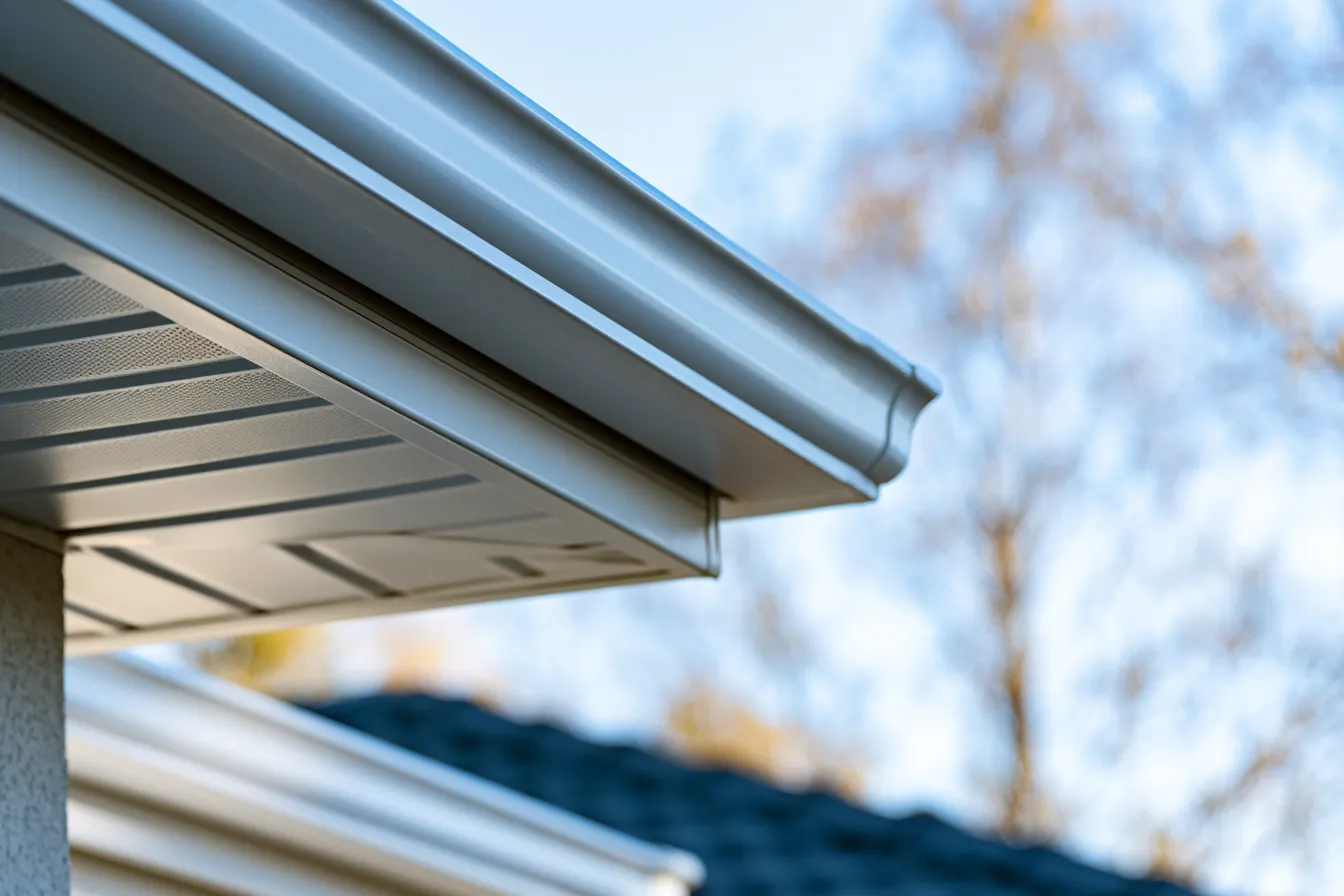
Gutter work and a new roof meet at the same few inches of edge, and that edge is only open once. If a new covering is already being weighed, both land on one estimate instead of two.
Getting a figure on the run that spills
Gutter work is short next to a roof. Usually it's one trip up to measure and one to hang the new run, with any rotten fascia coming off in between, and what stretches a gutter job out is weather more than work.
You describe it
Which side of the house, and what you've noticed: water going over, a sag in the line, streaks down the face, soft trim. You don't have to work out which of those it is.
Our roofers measure
They take the length of every run, the corners, the height off the ground and the number of drops. Then they push a screwdriver into the fascia in a few places to find out how sound the board really is.
You get it itemized
The run, the drops, guards if you want them, and any board that has to be replaced come back as separate lines, at no charge. You can see at a glance which of those is driving the number.
Signs Rowlett gutters are failing behind the fascia
Most of this shows at eye level, so you can get a fair way into a gutter problem without leaving the yard. What separates a cleaning from a real one is where the trouble sits: debris rides in the trough, while a run pulling loose is a story about the board behind it.
- Paint bubbling on the fascia: The board behind the gutter has been staying wet, and paint is the first thing to give.
- A screwdriver goes in easy: Sound trim pushes back against a poke, and wood that takes the tip without much argument is already gone.
- The gutter line waves: A run that dips between hangers is usually fasteners letting go of softened board, well before the trough itself bends.
- Water marks behind the trough: Stains on the wood between the gutter and the roof edge mean the water never made it in.
- Stains on the soffit panels: The underside is telling you water has been getting in above it, and that panel is the attic's air supply.
- A trough that never empties: Standing water days after a storm means the fall is gone or the outlet below it is blocked.
- Wasps or birds at the eave: A gap in the soffit or fascia is an open door, and wind-driven rain uses the same one.
One of these is enough to point at, and figuring out which of them matters is the job itself. Where the soffit is involved, that same panel is where the roof pulls its intake air, so both get looked at together.
What the measured run changes about the job
Gutters price off the measured run, so a figure comes after somebody has been up there with a tape. A long straight eave and a chopped-up roofline can carry the same tape reading and land nowhere near each other, because every corner is another sealed joint and every drop is another outlet to cut in. If a new covering is being weighed at the same time, what drives a roofing figure here covers that side of it.
See what drives a roofing figure- Measured footage, corner to corner
- How many corners the run turns
- Single story, or up over a second
- Number of downspouts and where they let out
- Five inch trough or six
- Fascia that has to come off first
- Guards, and how fine the mesh is
How rain behaves on a Rowlett gutter run
The storms that matter here come down hard and quit, so a gutter is sized against that short burst more than the year's total. Clearing debris helps; it can't fix a run that was never big enough.
- 01Six inch on bigger roofs
- A six inch trough carries more than a five, and roofers here reach for it on large, steep or cut-up rooflines. Little at install, a lot to retrofit.
- 02Drops closer together
- Downspout spacing tightens in downpour country, because a full trough with one outlet still backs up. Where each drop lets out matters too, well clear of the house.
- 03Aluminum, and its thickness
- Aluminum is the default; thickness matters more than brand. Heavier coil holds its shape against a ladder, a hail season and a loaded trough.
All of that stays general until a tape goes on your own run.
Gutter questions from Rowlett homeowners
Common questions about gutters, fascia, and where the water goes.
Q1My gutters overflow every time it rains hard. Do I need new ones?
Q2Is seamless really better than the sectional gutter I can buy at a store?
Q3Do gutter guards mean I never have to clean them again?
Q4Does any of this actually matter to the house, or is it just the yard?
Q5The fascia looks rotten. Is that a gutter job or a roof job?
Get your Rowlett gutters measured
Point at the side of the house that spills, and our roofers measure the run and the board behind it. Rotten fascia is a separate line from the gutter itself.