If your house went up in the wave of Rowlett plats filed between 1998 and 2004, the covering on it is somewhere between twenty two and twenty eight years old right now. That is old enough that the shingle sitting up there may not be the shingle anyone would put back on it. What follows is what was standard when those houses were built, how to tell from the yard which one you have, and what the choices look like today.
What builders were putting on Rowlett roofs back then
The city's own subdivision record puts a date on a lot of Rowlett's housing, and it's a better starting point than a guess. The Waterview phases were filed between 1998 and 2004 across roughly 470 acres, so if that's where you live, you can work the age of the original roof out instead of guessing at it. You can count from the plat. That's worth doing first, because the age of the covering decides which conversation you're in before anybody says a word about condition.
Those years were the crossover for asphalt. Three-tab was still an ordinary thing for a builder to specify, especially on a tract build where the roof was one line on a spec sheet and the cheapest real roof won. Architectural shingles existed and were climbing, and by the middle of the 2000s they'd taken over as the default. So a house finished in 1999 and a house finished in 2004, three streets apart, can be wearing two genuinely different products, and the older one is the one more likely to be flat and single-layer.
The second thing that dates a roof of this vintage is how many times it's already been done. A house filed in 2001 that took a bad hail season in the middle of its life may be on its second covering by now, and whether the first one came off or got covered over changes what a tear-off runs into later. It also changes the weight sitting on the framing. That's not something you can settle from the driveway, but it's something to know you don't know.
Telling three-tab from architectural without a ladder
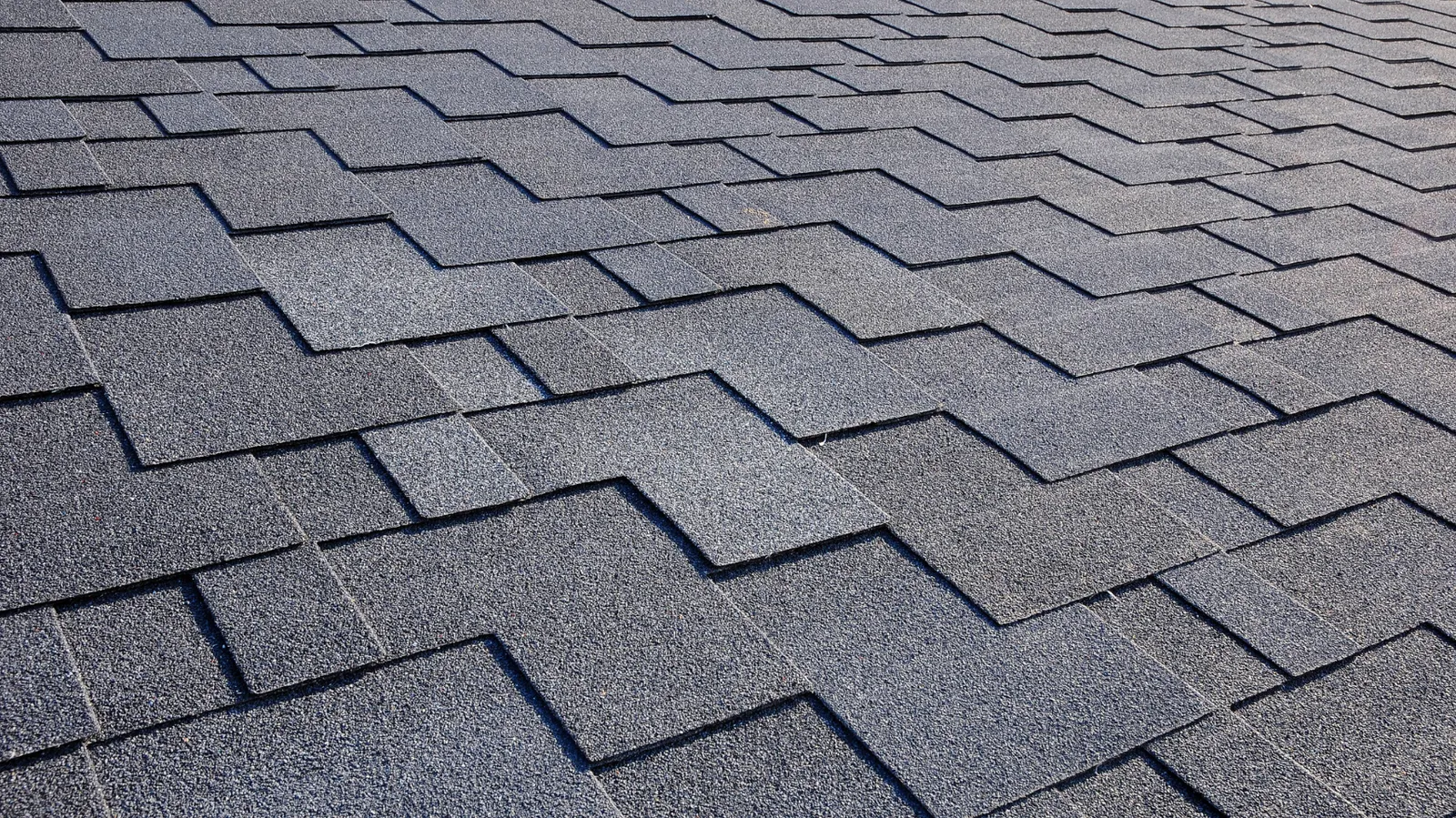
A three-tab roof reads flat, one plane with the same pattern repeated across it. The cutouts are evenly spaced and they line up course to course, so from the street you see an even, regular shadow line running all the way across the roof. There's no depth to it, because there's only one layer of material.
Architectural shingles, sometimes sold as laminate or dimensional, are two or more layers bonded together, and the tabs are cut irregularly on purpose. The shadow lines break up instead of marching in a row. Stand at the curb late in the afternoon when the sun is low and the difference is hard to miss: one roof looks printed on, and the other looks like it has thickness.
There's one more tell that costs nothing to check, and it's at ground level. Look in the gutters, then at where the downspouts let out. A roof shedding granules heavily leaves what looks like coarse black sand collecting there, and on a covering in its twenties that's the shingle reporting where it is in its own life. A handful of loose granules in the first year after a new roof is ordinary manufacturing loss. A steady build-up two decades later is a different thing entirely.
Your own paperwork settles the rest of it. If the roof's been done since you bought the house, the invoice names the product line. If the house is original and you were the first owner, the builder's file sometimes still has the spec. And if none of that turns up, the shingle itself carries a stamp, which makes it a thirty-second answer for one of our roofers already up there. If you go out and look and can't call it either way, that's a normal place to end up, and it isn't a question we'll make you feel small for asking.
Where a 1998 to 2004 Rowlett roof stands now
Asphalt gets planned at around twenty years, undifferentiated by grade. That last part matters, because the tidy split you'll read everywhere else, fifteen to twenty for three-tab against twenty five to thirty for architectural, has no primary source under it. It's a number that got copied until it sounded official. Around twenty, weather and workmanship and attic ventilation allowing, is the figure with something behind it.
So a roof laid on a house from a plat filed in 2000 is at twenty six. That's past the planning figure, and it's the reason houses in this window start getting looked at. It's also not a call on its own. Plenty of roofs run well past twenty on a shaded slope over a well vented attic, and plenty of roofs are finished at fourteen because of one afternoon. It's fair to come at a roof this age half expecting bad news. Sometimes what comes back is a few more summers, and we're glad when it does.
North Texas is what pulls the number down here, and it doesn't do it evenly across a roof. Hail takes the granules off first, and scattered granule loss on its own is usually cosmetic while the shingle is still covered. What matters is bruising, where the stone fractures the mat underneath and the top surface still looks fine. It feels soft under thumb pressure and it doesn't read from the yard at all. It also weathers into ordinary aging inside a few months, so the window where the evidence is clean is short.
The shingle that goes back on a Rowlett roof today
Architectural is the default now, and it's the default for reasons that have little to do with looks. It's heavier, and it's built in bonded layers instead of one flat sheet. On a tear-off here it's what goes back on unless there's a specific reason to go another way, and for most houses in that late-1990s window it's a clear upgrade on what came off.
Above that sits the impact-rated tier, and the one thing to understand about it is that it's not a fourth look. Class 4 rates how much a shingle takes, and it sits on top of whichever style you already picked, so an architectural shingle can be Class 4 or not be Class 4 and look identical on the roof from the street.
What the job costs is decided far less by which bundle you pick than most people expect. Squares, pitch, how many layers are coming off, what shape the decking turns out to be in once it's bare, and how many valleys, dormers and pipe penetrations cut the roof up move it much further than the shingle line does. What moves the number on a roof here walks through those in order.
One local wrinkle before you order anything. The Waterview phases carry a homeowners association, and whether yours wants a say in color or material is a five-minute question our roofers settle before a date gets booked. It occasionally saves a re-order.
What an impact rating buys, and what it does not
Class 4 is the top of a four-step scale, and it's earned in a lab. A two-inch steel ball is dropped at the shingle from about twenty feet, and the shingle passes if the back of the mat doesn't crack. Higher class means a bigger ball and a longer drop, and that's the whole of the test. It's a genuinely useful thing to know about a product, and in a hail metro it's usually the right call on a replacement.
Two limits come attached to it, and you should hear both before you decide. The first is that it's not hail proof. A big enough stone damages a Class 4 roof the same as any other, and the rating only reports what the shingle survived under a steel ball in a controlled drop.
The second one trips people up. An impact rating isn't warranty coverage. Manufacturer limited warranties on asphalt generally exclude hail damage outright, and that exclusion applies to impact-rated products too. The rating is a test result about the material. It says nothing about who pays after a storm, and the two get blurred together often enough that it pays to hold them apart.
Where an impact-rated roof can pay back is on the insurance side. Carriers in hail states may discount the premium for one, though how much swings a long way from one carrier to the next. Keep the invoice when the work is done, because a discount usually wants the specific product listed on paper.
Before the next hail season comes through
If you can date the house off the plat and the roof looks original, you already hold most of what you need. The missing piece is usually just that nobody's been on it. Rowlett Roofworks covers these streets, and our roofers work a roof one plane at a time instead of reading it off the driveway, because bruising and a lifted course don't show from down there and a sun-facing slope is rarely in the same shape as the shaded one.
If it turns out the covering has reached the end, a full replacement is a sequence rather than a single afternoon, and what the tear-off exposes underneath is what shifts the scope. If it hasn't reached the end, the shingle grades are still worth reading, because the choice you make at twenty six years old is the one you live with for the next twenty.
None of this has to be settled this week. Knowing which grade is up there, and roughly how much of it is left, puts you ahead of the decision instead of reacting to it after a storm's already made it for you.
Most of the time the only missing piece is that nobody has been up on the roof since it went on. Tell Rowlett Roofworks the address, plus the build year if you have it, and our roofers get on the roof and come back with the grade, the shape each slope is in, and how much life is left.
Find out what is on your roof